

- An SEO competitor analysis compares your site with the sites that outrank you, to find the keywords, content, links and technical advantages you’re missing.
- Your search competitors are whoever ranks for your target keywords. They’re often publishers, directories or marketplaces, not the businesses you compete with for sales.
- The most useful outputs are three lists: keywords to target, pages to create or improve, and websites to earn links or mentions from.
- In 2026, add AI search to the analysis: check which competitors ChatGPT, Perplexity and AI Overviews cite for your topics, and which sources they rely on.
You can guess why a competitor ranks above you, or you can look. An SEO competitor analysis replaces guesswork with a list: the keywords they win, the pages that win them, the sites that link to them and the technical details that give them an edge. Done well, it turns into a content and link plan you can start on the same week.
This guide walks through a seven-step SEO competitor analysis that works for a local business, a SaaS product or a content site. You can do it with free tools and a spreadsheet, and faster with a keyword and backlink tool. We’ll point out where each step fits into SEOPacket, but the method works with any toolset.
In this competitor analysis guide
What is SEO competitor analysis?
SEO competitor analysis is the process of researching the websites that rank for your target keywords, to understand why they rank and where you can beat them. It covers keywords, content, backlinks, technical SEO and, increasingly, visibility in AI answers.
It isn’t about copying. The goal is to find gaps: topics your competitors cover that you don’t, topics nobody covers well, and signals such as links or reviews where you’re clearly behind. A good competitor analysis SEO report ends with priorities, not just data.
Why competitor analysis matters for SEO
Search is relative. Google doesn’t rank pages against a fixed standard; it ranks them against each other for a query. Looking at the pages that currently win tells you what Google thinks searchers want: the format, depth, freshness and authority that query needs.
It also saves time. Instead of brainstorming topics from scratch, competitor keyword analysis shows you which topics already bring traffic in your niche. And backlink analysis shows you which sites are willing to link to content like yours.
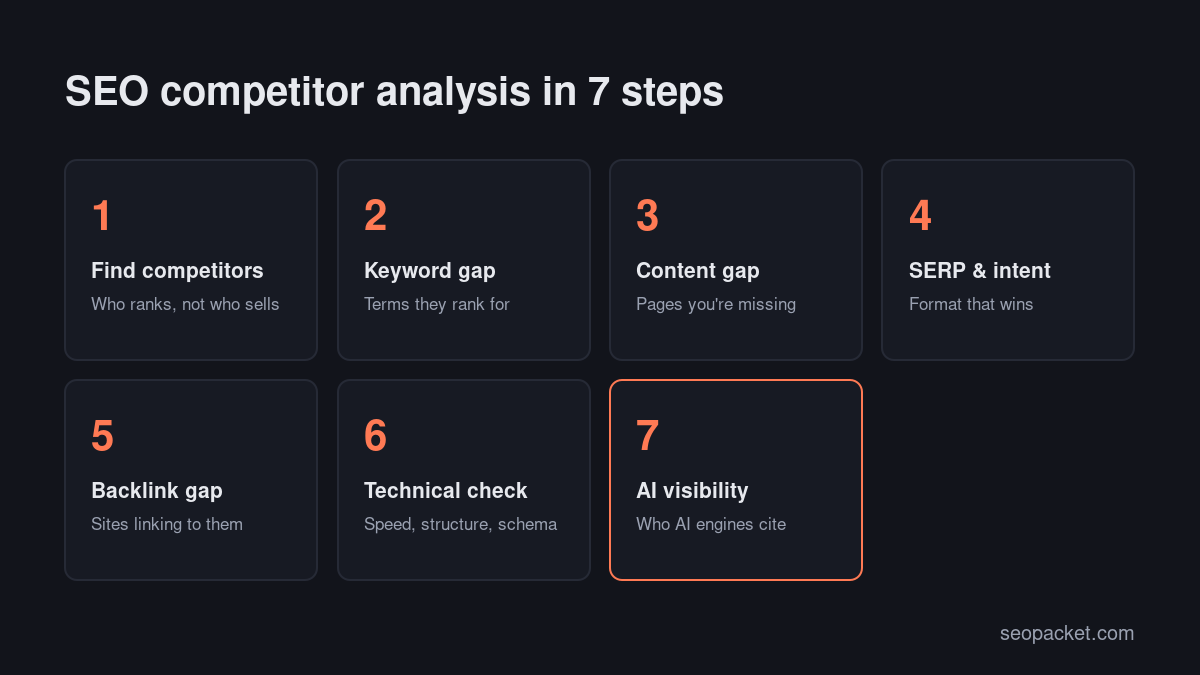
Step 1: Find your real search competitors
Your business competitors and your search competitors are often different. A local accounting firm might compete with three other firms for clients, but in search it competes with national publishers, software companies and government sites that rank for the same questions.
To find the sites you really compete with:
- List 10 to 20 keywords that matter most to your business, mixing commercial terms (“seo audit tool”) and questions (“how to check if a page is indexed”).
- Search each one in a private window, in the country you target, and note every domain in the top ten.
- Count how often each domain appears. The domains that show up across many of your keywords are your main search competitors.
- Group them by type: direct competitors, publishers and blogs, marketplaces and directories, and forums like Reddit.
Keyword tools can speed this up by showing domains that share the most keywords with you. SEOPacket’s Competitor gap feature compares your domain with your rivals and lists the keywords where they rank and you don’t.
Tip: pick three to five competitors for the deep dive. Analysing fifteen sites produces more data than you can act on.
Step 2: Run a competitor keyword analysis
Competitor keyword analysis shows which search terms bring your rivals traffic. You’re looking for three groups:
- Missing keywords: your competitors rank and you don’t rank at all.
- Weak keywords: you rank, but on page two or lower, while competitors are in the top ten.
- Shared wins: you and competitors both rank well. Protect these.
For each missing or weak keyword, note the search volume, keyword difficulty and intent. Then filter hard. A keyword only belongs on your list if it’s relevant to what you sell or teach, and if you could realistically publish the best page for it.
If you don’t have a keyword tool, Google itself is a decent free source. Look at “People also ask”, related searches and autocomplete for your main topics, and use Google search operators such as site:competitor.com topic to see how much a competitor has published on a subject.
Step 3: Analyse competitors’ top pages and content gaps
Keywords tell you what people search for. Top pages tell you what content wins. For each competitor, find the pages that bring the most organic traffic, usually a mix of guides, tools, comparison pages and category pages.
For every strong competitor page on a topic you want, ask:
- What format is it? A list, a step-by-step guide, a tool, a template, a comparison?
- How deep does it go? Which subtopics does it cover that yours doesn’t?
- How fresh is it? Is it updated for this year, with current screenshots and examples?
- Who wrote it? Is there a named author with real experience, as Google’s guidance on helpful, reliable content encourages?
- What does it offer that’s unique? Original data, a calculator, expert quotes, a downloadable checklist?
The content gap is the list of topics competitors cover well that you either don’t cover or cover thinly. Sort it by business value first, then by difficulty.
Step 4: Study the search results and intent
Before you write anything, look at the search results page for each target keyword. The SERP tells you what Google believes the intent is:
- Mostly guides and blog posts means informational intent. A product page won’t rank.
- Mostly product or category pages means commercial intent. A blog post will struggle.
- Mixed results mean Google isn’t sure, which is often an opportunity for a page that satisfies both.
Note the SERP features too. Featured snippets, “People also ask”, videos, local packs and AI Overviews all change how many clicks the organic results get and what format you need. If an AI Overview appears, note which sites it links to. That’s your competition for citations, which we’ll come back to in step 7.
Step 5: Find backlink gaps
Links from other websites are still one of the strongest signals of authority. A backlink gap analysis lists websites that link to your competitors but not to you.
Work through it like this:
- Pull the referring domains for each competitor, using a backlink tool. SEOPacket’s backlink checks, Ahrefs, Semrush and similar tools all show this.
- Find domains that link to two or more competitors but not to you. These sites have already shown they link to businesses like yours.
- Sort by relevance, not just authority. A link from a respected site in your niche beats a link from a high-authority site that has nothing to do with you.
- Look at why they link. Is it a resource page, a guest post, a tool mention, a roundup, a news story or a partnership? That tells you how to earn a similar link.
Avoid buying links or joining link schemes. Google’s spam policies treat paid links that pass ranking credit as a violation, and the risk isn’t worth a short-term gain. Our parent company, Soft Learn Hub, breaks down what paid backlink services cost and where the penalty risk lies.
Step 6: Compare technical SEO and user experience
Sometimes a competitor outranks you with similar content and fewer links because their site simply works better. Compare the basics:
- Speed and Core Web Vitals on mobile, using PageSpeed Insights for a few matching pages.
- Site structure: how many clicks from the homepage to key pages, and how well topics are interlinked.
- Structured data: do their pages show rich results such as FAQs, reviews or breadcrumbs that yours don’t?
- Indexing: a
site:search gives a rough sense of how many pages they have indexed compared with you. - Page layout: is their answer visible above the fold, or buried under ads and pop-ups?
The technical section of our SEO checklist covers what to fix on your own site once you’ve spotted the gaps.
Step 7: Check AI search visibility
A modern SEO competitor analysis needs one more step. More searchers now get answers from ChatGPT, Perplexity, Gemini and Google’s AI Overviews, and those answers cite a small number of sources. If your competitors are cited and you’re not, you’re losing visibility that doesn’t show up in rank trackers.
To compare AI visibility:
- Write 20 to 30 prompts that real customers ask, without mentioning any brand.
- Run them in the main AI engines and note which brands are mentioned and which URLs are cited.
- Look for patterns. Do the same competitors appear again and again? Do AI engines keep citing the same third-party roundups or review sites?
- Check the cited pages. They’re often well-structured pages with direct answers, clear headings and good schema.
SEOPacket’s AI answer checks automate this for the prompts you choose, and its free GEO readiness score shows whether your own pages are set up to be cited. Our guide to GEO vs SEO explains the differences in more detail.
A worked example
Here’s what this looks like in practice for a small project management app targeting freelancers.
Step 1 turned up five domains that appear again and again for its keywords: two direct competitors, a large software review site, a popular productivity blog and a Reddit community. The team chose the two direct competitors and the productivity blog for the deep dive, because the review site and Reddit weren’t realistic to outrank with a single page.
The keyword gap showed about 60 terms where competitors ranked and the app didn’t. After filtering for relevance, 18 were left, clustered into four topics: invoicing for freelancers, client onboarding templates, time tracking and project pricing. Looking at the search results showed that three of those topics wanted templates and one wanted a comparison page.
The backlink gap found a dozen sites linking to both competitors, mostly freelancer resource lists and a few podcast show notes. The AI check showed that ChatGPT and Perplexity kept citing the productivity blog’s template roundup when asked for client onboarding templates.
The resulting plan was short: publish three template pages and one comparison page over six weeks, pitch the resource lists once each page was live, and ask the productivity blog whether it would review the new templates. That’s the value of a focused SEO competitor analysis: a plan small enough to finish.
Adapting the analysis to your type of business
Local businesses
For local businesses, your competitors are the ones in the map pack as well as the organic results. Compare Google Business Profile details: categories, reviews, photos, opening hours and how often they post. Google’s guide on how to improve your local ranking lists relevance, distance and prominence as the main factors, so focus on the things you can control: complete profile details, genuine reviews and consistent contact details across directories.
SaaS and online tools
For software, the most valuable keywords are often “alternative” and “vs” searches, integration pages and use-case pages. Check which of these your competitors have built and how they handle comparisons fairly. Tools and templates also tend to attract links naturally, so look at which free tools competitors offer and whether you could offer a genuinely better one. You can see how SEOPacket structures its own features in our docs.
Content and affiliate sites
For publishers, compare topical depth. Count how many articles each competitor has on a subject, how they interlink them and how recently they were updated. Sites that cover a topic thoroughly and keep it current usually outrank sites with one strong article.
How to turn your SEO competitor analysis into a plan
Data only matters if it changes what you do next. Summarise everything into three lists:
| List | What goes in it | First action |
|---|---|---|
| Keywords | Missing and weak keywords with clear business value | Map each to an existing page or a new page |
| Content | Pages to create, and existing pages to expand or update | Brief the top five by value and difficulty |
| Links and mentions | Sites linking to several competitors, plus sources AI engines cite | Plan outreach or content they would genuinely reference |
Then set a realistic pace. For most small teams that means two new or improved pages a week, plus a handful of outreach emails, reviewed every month against rankings and traffic in Search Console.
Free vs paid tools for competitor analysis
You can do a basic SEO competitor analysis entirely for free: manual searches, Google’s autocomplete and related searches, search operators, PageSpeed Insights and the Rich Results Test. It’s slow, but it works for a handful of keywords.
Paid tools add scale: keyword and backlink databases, traffic estimates and historical data. You don’t necessarily need a monthly subscription for this. SEOPacket charges per check from a prepaid wallet, so you can run a competitor gap or backlink check when you need one and nothing in between. See pricing for how the wallet works. New accounts get a $1 credit to test the paid checks before spending their own money.
Common SEO competitor analysis mistakes
- Analysing the wrong competitors. Choose sites that rank for your keywords, not only companies you know from sales calls.
- Chasing every keyword they rank for. Big competitors rank for thousands of terms that don’t fit your business.
- Copying content instead of beating it. Matching a competitor’s article point for point rarely outranks it. Add experience, data, examples or a better format.
- Ignoring intent. If the results are all guides, a sales page won’t rank however good it is.
- Doing it once. Rankings shift. Repeat a light version of your SEO competitor analysis every quarter and after major Google updates.
How often should you run an SEO competitor analysis?
Run a full SEO competitor analysis when you launch a site, enter a new market or plan a big content push. After that, a quarterly review of competitors’ new top pages, new keywords and new backlinks is enough for most businesses. Monthly checks make sense in fast-moving niches such as software, finance and news, where competitors publish and update constantly.
Frequently asked questions
What is SEO competitor analysis?
SEO competitor analysis is researching the websites that rank for your target keywords to understand why they rank, and finding gaps in keywords, content, backlinks, technical SEO and AI search visibility that you can use to outrank them.
How do I find my SEO competitors?
Search your 10 to 20 most important keywords in the country you target and note which domains appear in the top ten most often. Those are your search competitors, even if they’re publishers or directories rather than direct business rivals.
Can I do competitor keyword analysis for free?
Yes, for a small set of keywords. Use manual searches, autocomplete, “People also ask” and site: searches to see what competitors publish. Keyword and backlink tools add traffic estimates and scale.
How many competitors should I analyse?
Three to five is usually enough for a detailed analysis. Choose the domains that appear most often in the top ten for your target keywords.
How often should I repeat an SEO competitor analysis?
Do a full analysis at launch or before a major content push, then a lighter quarterly review. Fast-moving industries may need monthly checks.

Leave a Reply