

- Generative engine optimization tools measure how often AI assistants such as ChatGPT, Perplexity, Gemini and Google’s AI Overviews mention or cite your brand, and which pages they quote.
- Most GEO tools fall into two groups: monitoring platforms that track prompts and citations, and site tools that fix the technical reasons AI engines skip your pages.
- Before paying for tracking, make sure AI crawlers can reach your site, your key pages answer questions directly and your Organization schema is valid. Those checks are free.
- Pick a tool by the engines it covers, how it samples prompts, whether it shows cited URLs and whether its pricing fits the number of questions you actually need to track.
Search is splitting in two. People still type queries into Google, but more of them now ask ChatGPT, Perplexity, Gemini or Google’s AI Mode and read a single generated answer. That answer quotes a handful of sources, and if yours isn’t one of them, you don’t exist for that reader. A new category of generative engine optimization tools has appeared to measure exactly that.
If you’re looking for the best tools for generative engine optimization, this guide compares nine generative engine optimization tools we think are worth a look in 2026, explains what each one actually measures, and shows how to choose between them. We make one of the tools on this list, SEOPacket, and we say so where it appears. Features and plans in this market change every few months, so treat this as a map and check each vendor’s own page before you buy.
In this GEO tools guide
What are generative engine optimization tools?
Generative engine optimization tools are software that tracks and improves how AI search engines describe, mention and cite your brand. Where a rank tracker tells you your position in Google’s blue links, a GEO tool tells you whether ChatGPT recommends you when someone asks “what’s the best accounting software for freelancers”, and which of your pages it quoted.
Under the hood most of them do the same thing. They send a list of prompts to one or more AI engines on a schedule, store the answers, and parse them for brand mentions, links, sentiment and competitors. The better ones repeat each prompt several times, because AI answers vary from run to run, and report an average rather than a single snapshot.
If you’re new to the idea, our guide to GEO vs SEO explains how generative engine optimization differs from classic SEO and why the two work best as one plan.
Why do GEO tools matter now?
AI answers are becoming a front door to the web. Google shows AI Overviews on a growing share of informational searches, and Google’s own documentation on AI features in Search says the same signals that make a page eligible for normal results also make it eligible to appear as a link in those features. Meanwhile, assistants like ChatGPT search the web live and cite a few sources per answer.
Three things make measurement hard without dedicated GEO tools:
- Answers aren’t stable. The same question can produce different sources an hour later. You need repeated sampling, not a one-off check.
- There’s no Search Console for most AI engines. Google Search Console folds AI Overview clicks into normal Search data, and most assistants publish no referral reports at all.
- Mentions often come without links. An assistant may recommend your brand by name without linking to you, which analytics will never show.
That’s the gap these tools fill. They won’t make an AI engine cite you, but they show you where you stand and which pages to fix.
How we compared these generative engine optimization tools
We looked at each tool against the same six questions, summed up in the chart below. None of the vendors paid to be included, and there are no affiliate links in this article.
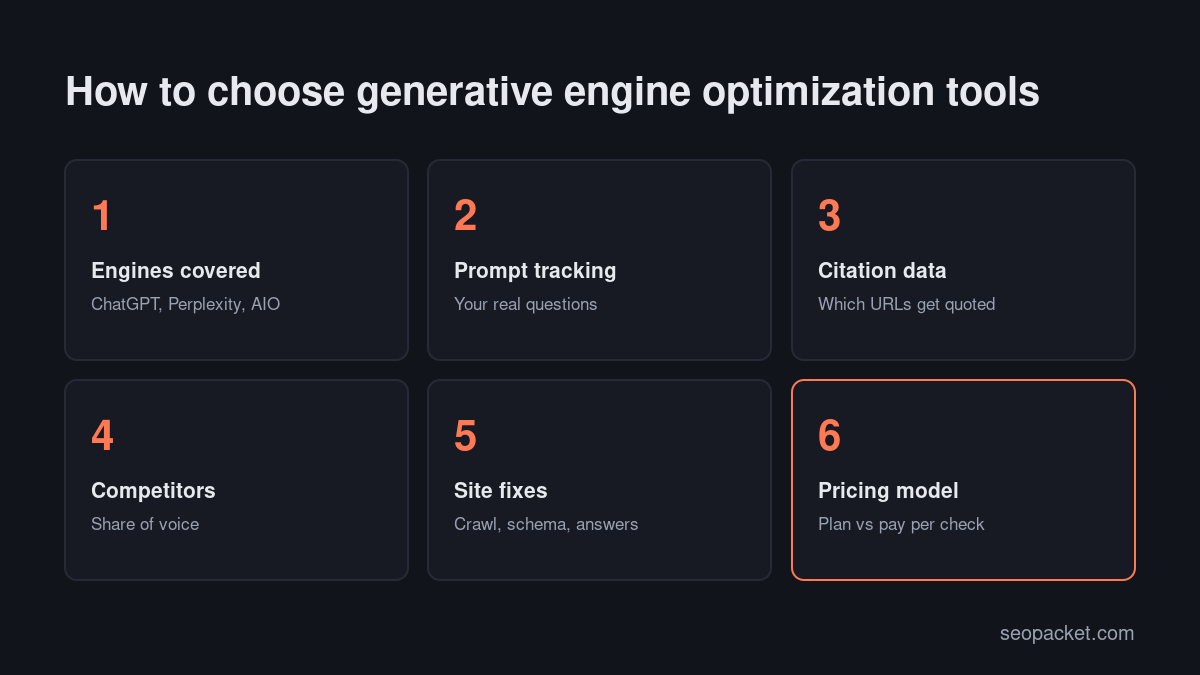
- Engines covered. At minimum ChatGPT, Perplexity and Google AI Overviews. Gemini, Claude, Copilot and AI Mode are a plus.
- Prompt tracking. Can you track your own questions, in your own markets and languages, rather than a fixed keyword list?
- Citation data. Does it show which URLs were cited, not just whether your brand was named?
- Competitor view. Share of voice against named competitors across the same prompts.
- Site fixes. Does it help you fix the reasons you’re not cited, such as blocked crawlers, missing schema or pages with no direct answers?
- Pricing model. Monthly plan by prompt volume, enterprise contract, or pay per check.
The best generative engine optimization tools in 2026
Here’s the short version before the detail. “Monitoring” means prompt and citation tracking; “site checks” means audits of the page-level signals that affect whether you’re cited.
| Tool | Best for | Monitoring | Site checks | Pricing model |
|---|---|---|---|---|
| SEOPacket (ours) | Small teams, WordPress sites, MCP users | AI answer checks per prompt | Free GEO readiness score and site crawl | Pay per check, $1 free credit |
| Profound | Enterprise brands | Large-scale prompt tracking | Content and crawler insights | Monthly plans and enterprise |
| Peec AI | Marketing teams tracking many prompts | Daily prompt tracking | Source analysis | Monthly plans, free trial |
| Otterly.AI | Agencies and SMBs starting out | Prompt and citation monitoring | GEO audit | Monthly plans |
| Semrush AI Visibility | Teams already on Semrush | Brand visibility across AI engines | Linked to Semrush site audit | Add-on to Semrush |
| Ahrefs Brand Radar | Teams already on Ahrefs | Brand mentions and cited pages at scale | Linked to Ahrefs site tools | Part of Ahrefs plans |
| SE Visible | Brand and PR teams | Visibility and sentiment scores | Linked to SE Ranking | Monthly plans |
| Rankscale | Budget-conscious teams | Citation source mapping | AI readiness audit | Low-cost monthly plans |
| AthenaHQ | Data-driven and ecommerce teams | Prompt volume tracking | GEO score | Monthly and enterprise |
1. SEOPacket
Full disclosure: this is our tool. SEOPacket combines a free technical side with pay-per-check AI monitoring. The free part crawls your site, audits single pages and gives every page a 0 to 100 GEO readiness score that checks AI crawler access in robots.txt, snippet controls, valid structured data, entity schema, question-style headings, direct answers under headings and llms.txt. The paid part runs AI answer checks for the prompts you choose and shows whether your brand was mentioned and which sources were cited.
It suits small teams and WordPress sites that want to fix the basics first and only pay when they need fresh AI answer data. There’s no subscription: you top up a wallet and each check shows its price before you run it, and new accounts get a $1 credit to test the paid checks. It also ships an MCP server, so you can run GEO checks from Claude or another AI assistant. It won’t match the prompt volumes of enterprise platforms, and it doesn’t sample every prompt dozens of times, so very large brands will want a dedicated monitoring tool alongside it.
2. Profound
Profound is one of the best-funded companies in the category and focuses on AI search visibility for large brands. It tracks how brands appear across the major AI engines at scale, with reporting on mentions, citations and competitors, plus insights into how AI crawlers interact with your site. It’s built for enterprise marketing teams with the budget and the prompt volume to use it fully.
3. Peec AI
Peec AI is a monitoring platform popular with marketing teams that want clean daily tracking of a defined prompt set. You group prompts by topic, track visibility, position and sentiment over time, and see which sources AI engines lean on for each topic, which is useful for finding the third-party pages worth getting featured on. It offers tiered monthly plans and a free trial.
4. Otterly.AI
Otterly.AI is a straightforward monitoring tool that tracks brand mentions and cited links for your prompts across the main AI engines, and adds a GEO audit for your site. It’s a sensible starting point for agencies and small businesses that want regular reporting without enterprise pricing.
5. Semrush AI Visibility
If your team already lives in Semrush, its AI visibility features are the path of least resistance. They show how your brand appears across AI engines, how you compare with competitors and which prompts trigger mentions, next to the SEO data you already use. It’s sold as an addition to Semrush rather than as a standalone GEO tool, so it makes most sense for existing customers.
6. Ahrefs Brand Radar
Ahrefs Brand Radar tracks brand mentions, impressions and cited pages across AI answers using Ahrefs’ own large prompt database, so you can see visibility without writing every prompt yourself. It’s strongest for competitive research: which brands and domains AI engines cite most in your niche. Like Semrush’s tools, it’s part of the wider Ahrefs platform.
7. SE Visible
SE Visible, from the team behind SE Ranking, focuses on brand visibility and sentiment across AI Overviews, AI Mode, ChatGPT, Gemini and Perplexity, with competitor benchmarking. It leans toward brand, PR and agency teams who care about how AI engines describe a company as much as whether they cite it.
8. Rankscale
Rankscale is one of the more affordable monitoring options. It maps which sources AI engines cite for your prompts, tracks sentiment and includes an AI readiness audit. It’s a good fit if you want citation data without a large monthly commitment.
9. AthenaHQ
AthenaHQ tracks prompts across a broad set of AI engines, estimates prompt volume and gives a GEO score, with integrations aimed at ecommerce teams. It’s priced for teams that will act on detailed data every week.
Free GEO tools and checks to run first
Before you pay for any of the generative engine optimization tools above, run the free checks. Tracking only tells you there’s a problem; these tell you why.
- Robots.txt access. Make sure you aren’t blocking the crawlers that power AI search, such as OAI-SearchBot, PerplexityBot and Bingbot. OpenAI documents its crawlers on its bots page. Blocking training crawlers like GPTBot is a separate choice and doesn’t stop live search citations.
- Snippet controls. A
nosnippetormax-snippet:0directive can stop Google from quoting your page in AI features. - Structured data. Validate your Organization, Article and FAQ markup with Google’s Rich Results Test. Invalid JSON-LD is ignored.
- Direct answers. Read your key pages. Does each question-style heading get a one or two sentence answer immediately below it?
- Indexing. AI features in Google only draw on indexed pages. If a page isn’t indexed, fix that first with our guide to getting pages indexed by Google.
- Bing. ChatGPT search and Copilot rely heavily on Bing’s index, so verify your site in Bing Webmaster Tools and submit your sitemap there too.
SEOPacket’s GEO readiness score runs most of these checks on every page for free. Sign up and you get a $1 credit on top if you want to try AI answer checks afterwards.
How to choose the right GEO tool
Start with the question you’re trying to answer, not the feature list.
If you need to know whether AI engines mention you at all
You need light monitoring: 20 to 50 prompts that mirror what customers really ask, checked weekly across ChatGPT, Perplexity and AI Overviews. A low-cost monitoring plan or pay-per-check tool covers this. Spending enterprise money here is premature.
If you’re not being cited and don’t know why
You need site checks before monitoring. Crawl the site, look for blocked AI crawlers, pages that aren’t indexed, weak internal linking, missing schema and pages that bury the answer. Our SEO checklist has a full GEO section you can work through.
If you’re competing for share of voice in a crowded market
You need a dedicated monitoring platform with repeated sampling, competitor tracking and cited-source analysis, so you can see which third-party pages AI engines trust and work on getting featured there. This is where the enterprise-focused tools earn their price.
Questions to ask any vendor
- Which AI engines and which models do you query, and from which countries?
- How many times do you run each prompt, and do you report averages or single answers?
- Do you store the full answer text so I can audit it?
- Can I see the exact URLs cited, including competitors’ pages?
- What happens to my data, and can I export it?
What GEO tools can’t do
Be sceptical of any tool that promises to “get you into ChatGPT”. No tool can guarantee an AI engine will cite you, because the engines decide based on relevance, authority and how well your content answers the question. What good generative engine optimization tools do is shorten the feedback loop: you change a page, and a few weeks later you can see whether citations moved.
The underlying work is the same work that makes pages rank in normal search. Google’s guidance on creating helpful, reliable content applies just as much when the reader is an AI system summarising your page.
Common mistakes when buying GEO tools
- Tracking vanity prompts. Brand-name prompts almost always return your brand. Track the unbranded questions buyers ask before they know you.
- Trusting a single run. One answer is an anecdote. Look for averages across several runs and several days.
- Ignoring the cited sources. The most useful data in GEO tools is often the list of third-party pages AI engines cite. Getting mentioned on those pages can move visibility faster than editing your own site.
- Buying monitoring before fixing access. If your robots.txt blocks AI search crawlers, no dashboard will show improvement.
- Measuring too often. Weekly is plenty for most brands. Daily data mostly shows noise.
Our recommendation
The best tools for generative engine optimization are the ones you’ll actually use every week. For most small and mid-sized sites, the best approach is two steps. First, use free checks, including SEOPacket’s GEO readiness score, to make sure AI engines can crawl, understand and quote your pages. Second, pick one monitoring tool that matches your budget and track a focused list of real customer questions for at least a month before judging results.
Larger brands competing on share of voice should add a dedicated platform with repeated sampling and competitor source analysis. Whatever you choose, the tool is only the scoreboard. The citations come from clear, trustworthy pages that answer the question better than anyone else.
Frequently asked questions
What are generative engine optimization tools?
Generative engine optimization tools track and improve how AI search engines such as ChatGPT, Perplexity, Gemini and Google AI Overviews mention and cite your brand. Most send your prompts to AI engines on a schedule, store the answers and report brand mentions, cited URLs, sentiment and competitors.
Are there free GEO tools?
Yes. You can check AI crawler access in robots.txt, validate structured data with Google’s Rich Results Test and review indexing in Search Console for free. SEOPacket’s site crawl and GEO readiness score are also free, and new accounts get a $1 credit for paid AI answer checks.
Can a GEO tool guarantee my brand will be cited by ChatGPT?
No. AI engines choose sources based on relevance, authority and how well a page answers the question. GEO tools measure visibility and highlight what to fix, but no tool can guarantee citations.
How many prompts should I track?
Start with 20 to 50 unbranded questions that real customers ask, grouped by topic. Track them weekly for at least a month before drawing conclusions, because AI answers vary from run to run.
Do I still need SEO tools if I use a GEO tool?
Yes. AI engines rely on crawlable, indexed, well-structured pages, which is classic technical SEO. Most teams use GEO tools alongside their existing SEO tools rather than instead of them.
