

- GEO vs SEO comes down to one difference: SEO earns a ranked link in Google, while GEO (generative engine optimization) earns a citation inside an AI answer from ChatGPT, Perplexity, Claude or Google AI Overviews.
- AI engines quote pages that use question headings, short direct answers, clear definitions, specific facts and valid structured data.
- GEO builds on SEO: a page still has to be crawlable, indexable and trusted before any AI engine can cite it.
- Allow AI search crawlers such as OAI-SearchBot, PerplexityBot and Claude-SearchBot in robots.txt, and track citations the way you track rankings.
In this guide
GEO vs SEO is the question every site owner is now asking, because a growing share of searches end inside an AI answer instead of a list of links. For twenty years, ranking meant one thing: showing up on page one of Google. That still matters. But ChatGPT, Perplexity, Google’s AI Overviews and Claude now summarise the web for their users, and generative engine optimization (GEO) is the practice of making your content the source those summaries pull from and cite.
This guide explains what GEO is, the five differences between GEO and SEO that change how you write and structure pages, how AI engines choose which sources to cite, and a practical plan for optimising for both at the same time.
What is generative engine optimization (GEO)?
Generative engine optimization (GEO) is the practice of structuring and writing web content so that AI answer engines, such as ChatGPT search, Perplexity, Claude and Google AI Overviews, can find it, understand it and cite it as a source in their generated answers.
The term was popularised by a 2023 research paper, “GEO: Generative Engine Optimization”, which found that adding elements such as statistics, quotations and cited sources to a page measurably increased how often it appeared in generative engine responses. The idea has since become a working discipline for marketers and site owners who noticed that their traffic from informational queries was shifting into AI answers.
What is SEO?
Search engine optimization (SEO) is the practice of improving a website so that search engines like Google and Bing crawl it, index it and rank its pages highly in their results for relevant searches. SEO covers technical health, on-page content, and off-page signals such as backlinks. The reward is a position in a list of links, and a click from the searcher to your page. Understanding that reward first makes the GEO vs SEO comparison much easier to follow.
GEO vs SEO: 5 key differences
GEO and SEO share most of their foundations, but they optimise for different kinds of reader. SEO optimises for a ranking algorithm that returns URLs. GEO optimises for a language model that reads your page, extracts a claim or an answer, and presents it inside its own response. That single shift produces five practical differences.
1. The goal: a ranking versus a citation
The goal of SEO is to rank a page as high as possible in a list of results. The goal of GEO is to be one of the few sources an AI engine quotes or links to when it answers a question. A page can rank third in Google and still never be cited by an AI engine, and the reverse can also happen: AI engines sometimes cite pages that rank outside the top ten because they contain the clearest direct answer.
2. Where you appear
In the GEO vs SEO split, placement is the most visible difference. SEO results appear in organic listings, featured snippets and other search features. GEO results appear inside ChatGPT search answers, Perplexity responses, Claude’s web search results and Google AI Overviews, usually as a small citation link or a named source next to a sentence the model wrote.
3. How success is measured
SEO success is measured in rankings, impressions and clicks, all visible in Google Search Console. GEO success is measured in how often your brand is mentioned and cited in AI answers for the questions your customers ask. Clicks still matter, but many AI answers satisfy the reader without a click, so brand visibility becomes the leading indicator.
4. What content wins
SEO rewards comprehensive, relevant pages that match search intent. GEO rewards content a model can lift cleanly into an answer:
- Direct, quotable answers. Lead each section with a one- or two-sentence answer to the question in the heading. Models tend to extract the sentence closest to the question.
- Structured, scannable formatting. Headings, lists and tables parse more reliably than long unbroken paragraphs. Every H2 should be a real question or a real claim, not a vague label.
- Specific numbers and named sources. “Many websites see improvements” is unusable to a model. A specific figure with a named, linked source is quotable because it is concrete and attributable.
- Clear definitions. A single sentence that defines a term (“X is…”) is exactly the shape AI engines reuse when a user asks “what is X?”.
- Freshness and provenance. A visible last-updated date and a named author with real expertise help both people and models judge how far to trust a page.
5. Technical requirements
SEO needs a crawlable, indexable, fast site with good internal linking. GEO needs all of that plus access for AI crawlers, snippet permissions and machine-readable structure. OpenAI documents its crawlers in its bots overview: OAI-SearchBot powers ChatGPT search, while GPTBot collects training data. Google explains how its AI features use your content in AI features and your website, and snippet controls such as nosnippet are covered in its robots meta tag documentation.
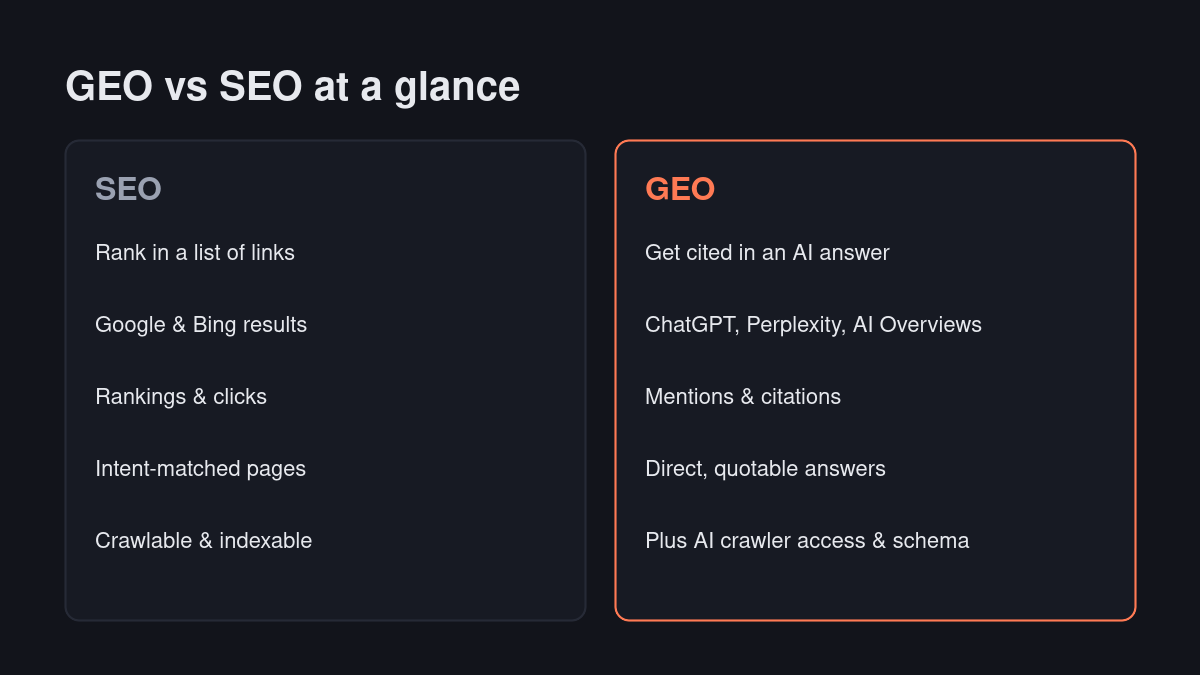
GEO vs SEO at a glance
| SEO | GEO | |
|---|---|---|
| Goal | Rank a page in Google’s list of results | Get quoted and cited inside an AI-generated answer |
| Where you appear | Organic results, featured snippets | ChatGPT search, Perplexity, Google AI Overviews, Claude |
| Success signal | Rankings, clicks, impressions | Brand mentions and source citations in AI answers |
| Content that wins | Relevant, comprehensive pages matching search intent | Question headings, short direct answers, clear definitions, facts an AI can quote |
| Technical basics | Crawlable, indexable, fast, internally linked | All of SEO’s basics plus AI crawler access, valid JSON-LD and entity schema |
How do AI search engines choose which pages to cite?
Most AI search engines follow a retrieve-then-generate pattern. When a user asks a question, the engine runs one or more searches against its own index or a partner’s, pulls a handful of the most relevant pages, and writes an answer grounded in those pages, citing some of them. That is where GEO vs SEO overlap most, and why SEO still matters for GEO: a page that isn’t in the index can’t be retrieved, and a page that can’t be retrieved can’t be cited.
From the retrieved set, engines favour pages that answer the question directly, come from sources that look trustworthy, and are easy to parse. Pages that bury the answer under long introductions, hide text behind scripts, or block AI crawlers lose out even when they rank well in classic search.
Which AI search engines should you optimize for?
Generative engine optimization isn’t one channel. Each AI engine finds its sources differently, which is why the GEO vs SEO comparison changes slightly depending on where your audience asks questions:
- Google AI Overviews and AI Mode draw on Google’s own search index, so ordinary Google SEO is the entry ticket. Pages that already rank and answer questions clearly are the most likely to be quoted.
- ChatGPT search uses OpenAI’s own crawler, OAI-SearchBot, alongside third-party search providers, so being crawlable by OAI-SearchBot and well indexed in Bing both help.
- Microsoft Copilot is grounded in Bing’s index, which makes Bing Webmaster Tools and IndexNow worth setting up.
- Perplexity crawls with PerplexityBot and tends to cite several sources per answer, which gives smaller, specialist sites a real chance to appear.
- Claude can search the web and uses Anthropic’s Claude-SearchBot to fetch pages for its answers.
You don’t need a separate strategy for each. Allow all their search crawlers, stay indexed in both Google and Bing, and write answer-first content; that covers the large majority of AI search traffic.
SEO vs GEO in practice: the same answer written two ways
The easiest way to see the GEO vs SEO difference is to compare two versions of the same section. Imagine a page targeting the question “how often should I update my sitemap?”
A typical SEO-first version opens with context: why sitemaps matter, a short history, the keyword repeated in the first sentence, and the actual answer three paragraphs down. It can still rank, because the page as a whole is relevant.
A GEO-ready version puts the answer first: “Update your XML sitemap automatically whenever you publish, update or delete a page; most SEO plugins do this for you, so you rarely need to touch it manually.” The explanation, exceptions and examples follow underneath. A language model can lift that first sentence straight into an answer and cite the page as its source.
The GEO-ready version is also better for human readers, which is the pattern to remember: generative engine optimization mostly rewards the habits good editors already recommend.
Does GEO matter for small businesses and WordPress sites?
Yes, and arguably more than for large brands. AI answers often cite a handful of specific, well-structured pages rather than the biggest domain, so a small business with a clear answer to a niche question can be cited alongside much larger competitors. On WordPress, most generative engine optimization work needs no new tools: an SEO plugin for schema, a check of your robots.txt, and a rewrite of your most important posts so each heading is followed by a direct answer.
What stays the same
GEO does not replace technical SEO fundamentals. A page still needs to be crawlable, indexable, fast and linked to from elsewhere. AI crawlers reuse much of the same infrastructure as search crawlers, and the main ones, including OAI-SearchBot, GPTBot and PerplexityBot, follow robots.txt rules the way Googlebot does. Google also offers the Google-Extended control token in robots.txt, which governs whether your content is used to improve Gemini models without affecting Google Search. If a page cannot be indexed, it cannot be cited either.
How to optimize for GEO and SEO together
The good news in the GEO vs SEO debate is that you rarely have to choose. The same page can rank in Google and be cited by AI engines if you follow these steps:
- Fix technical SEO first: make sure every important page is indexable, fast and internally linked.
- Check robots.txt for AI crawlers you may be blocking by default. Some security plugins and CDN settings block them without telling you.
- Rewrite headings as the questions your customers ask, and put a one- or two-sentence answer directly underneath each one.
- Add a clear definition for every key term the page is about.
- Support claims with specific numbers and link to the primary source.
- Add structured data: Organization sitewide, Article or BlogPosting on posts, and FAQPage where the page genuinely answers common questions.
- Publish an llms.txt file that summarises your most important pages for language models.
If your pages aren’t indexed yet, start with our guide to getting WordPress pages indexed by Google faster, because no amount of GEO work helps a page search engines can’t see.
How do you measure GEO results?
You measure GEO by tracking whether AI engines mention and cite your brand for the questions that matter to your business. Measuring GEO vs SEO side by side works best with the same set of topics. Start with a list of 20 to 30 real customer questions, run them through ChatGPT search, Perplexity and Google, and record whether your domain is cited, mentioned without a link, or absent. Repeat monthly.
- Citation rate: the share of your tracked questions where your domain is cited as a source.
- Referral traffic: visits from chatgpt.com, perplexity.ai and similar referrers in your analytics.
- Branded search: growth in searches for your brand name, which often rises as AI engines mention you.
SEOPacket’s AI answer checks automate this tracking, and its free GEO readiness score shows which pages are ready to be cited.
How long does generative engine optimization take to work?
Generative engine optimization works on a similar timescale to SEO, because AI engines depend on crawling and indexing first. Changes to robots.txt and structured data can take effect as soon as the relevant crawlers revisit your pages, often within days. Rewriting content into answer-first sections usually shows up in AI answers over several weeks, as pages are recrawled and engines refresh the sources they rely on. Citations for competitive topics take longer, because you’re also building the authority that makes an engine trust your page over others.
Treat GEO as an ongoing practice rather than a one-off project. Re-check your tracked questions every month, update pages when the facts change, and keep adding content that answers the questions your customers actually ask. In the long run, the GEO vs SEO split matters less than the habit underneath both: publishing the clearest, most trustworthy answer on the topics you know best.
Common GEO vs SEO mistakes
- Blocking every AI bot. Blocking training crawlers is a legitimate choice, but blocking AI search crawlers such as OAI-SearchBot removes you from those answers entirely.
- Writing for keywords instead of questions. Pages optimised around a repeated phrase rarely contain the crisp answer a model is looking for.
- Burying the answer. Long introductions push the useful sentence too far from the heading for a model to connect them.
- Unverifiable claims. Statistics without a named source are less likely to be quoted and can damage trust if they’re wrong.
- Ignoring SEO. GEO without indexing, speed and links has nothing to stand on.
Most GEO vs SEO mistakes come from treating the two as separate projects with separate teams and separate content. They work best as one plan.
GEO is not a replacement for SEO. It is the same discipline of being useful, specific and well-structured, applied to a reader that happens to be a model instead of a person.
Frequently asked questions
What is the difference between GEO and SEO?
SEO optimises a page to rank in search engine results pages, while GEO optimises the same page to be read, quoted and cited inside AI-generated answers from tools like ChatGPT, Perplexity, Claude and Google AI Overviews. SEO is measured in rankings and clicks; GEO is measured in brand mentions and citations.
Is GEO replacing SEO?
No. GEO depends on SEO. AI search engines still discover, crawl and trust pages through the same signals Google uses, so GEO is best treated as an extra layer on top of solid technical SEO.
How do I know if AI search engines cite my site?
Ask the questions your customers ask in AI search engines and check whether your domain appears as a source. SEOPacket’s AI answer checks automate this and report whether you were cited, only mentioned, or left out.
Does blocking GPTBot stop ChatGPT from citing my site?
Not necessarily. GPTBot is OpenAI’s training crawler; ChatGPT search uses OAI-SearchBot. You can block training while still allowing AI search to read and cite your pages.
What is llms.txt?
llms.txt is a plain-text file at the root of a site that summarises its most important pages for large language models. It is an emerging convention rather than an official standard, but it is quick to add and some AI tools read it.

Leave a Reply