

- SEO improves a website’s visibility in search engines like Google and Bing. App store optimization (ASO) improves an app’s visibility and downloads in the Apple App Store and Google Play.
- Both depend on matching what people search for, but app stores weigh downloads, ratings, retention and conversion rate heavily, while search engines weigh content quality and links.
- Keywords work differently: app stores index a few short metadata fields, while search engines read your whole page.
- The two work best together. A strong website helps your app get found on the web, and app store listings can rank in Google too.
If you build an app, you’ll hear two acronyms constantly: ASO and SEO. They sound similar, and they share a goal, getting found by people who are searching, but they happen in different places, follow different rules and use different tools. Treating them as the same thing is one of the most common mistakes app teams make.
This guide explains ASO vs SEO in plain terms: what each one is, the seven differences that matter most, where they overlap and how to plan both together. It’s written for app founders, marketers and developers who need to decide where to spend limited time.
In this ASO vs SEO guide
What is SEO?
Search engine optimization (SEO) is the practice of improving a website so it ranks higher in search engines such as Google and Bing, and increasingly appears in AI answers from tools like ChatGPT and Perplexity. It covers technical work (making pages crawlable and fast), on-page work (content, titles and structure) and off-page work (links and mentions from other sites).
The result of good SEO is more visitors from search to your website: people who can learn about your product, read your guides and click through to download or sign up. Our complete SEO checklist covers every part of it.
What is app store optimization (ASO)?
App store optimization (ASO) is the practice of improving an app’s listing so it ranks higher in app store search results and converts more of the people who see it into downloads. The two main stores are Apple’s App Store and Google Play.
ASO covers two things. First, visibility: choosing the right keywords for your app’s title and metadata so it appears for relevant searches. Second, conversion: making the icon, screenshots, preview video, ratings and description persuasive enough that people tap “Get” or “Install”. Apple’s guide to creating your product page is a good overview of the elements you control on iOS.
ASO vs SEO at a glance
| Where it happens | Google, Bing and AI search engines | Apple App Store and Google Play |
|---|---|---|
| What ranks | Web pages | App listings |
| Key ranking signals | Relevance, content quality, links, page experience | Relevance of metadata, downloads, ratings, retention, conversion rate |
| Keyword placement | Anywhere on the page, especially titles and headings | A few short metadata fields |
| Conversion assets | Title and snippet, then the page itself | Icon, screenshots, video, ratings |
| Update speed | Instant, then waits for recrawling | Metadata changes usually go through app review |
| Main tools | Search Console, Bing Webmaster Tools, SEO tools | App Store Connect, Google Play Console, ASO tools |
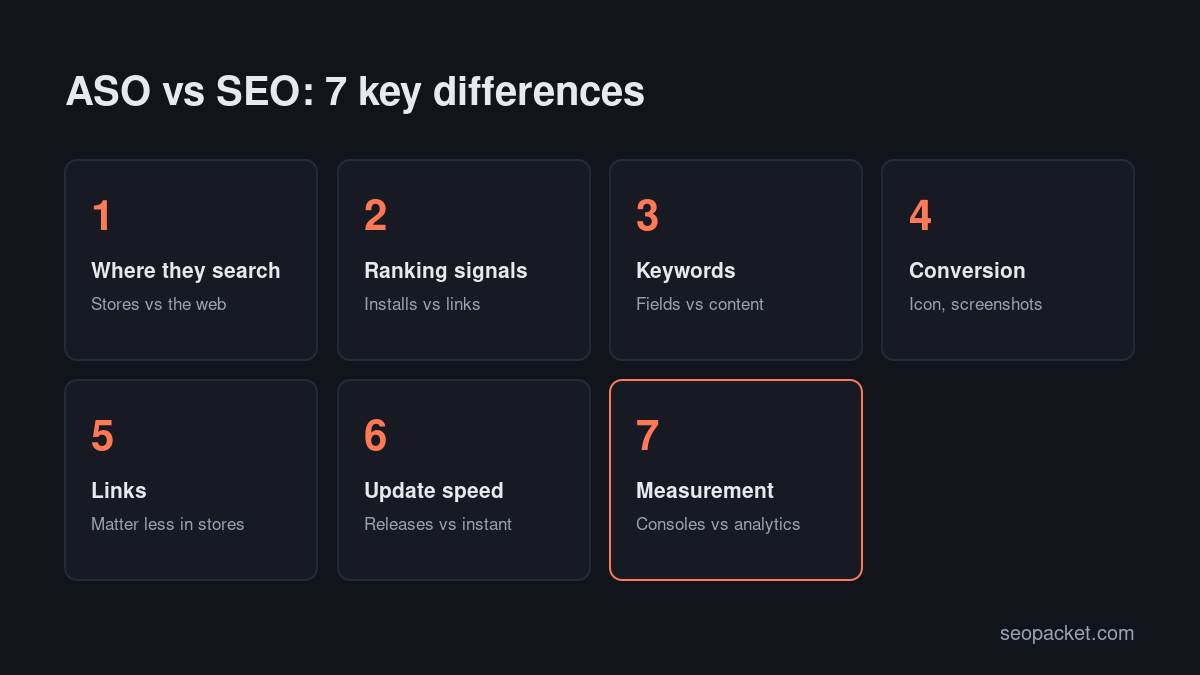
The 7 key differences between ASO and SEO
1. Where people search
SEO targets the open web. Someone searching “how to track expenses” in Google might want an article, a spreadsheet template or an app. ASO targets people already inside an app store, who almost always want to install something. That makes app store traffic narrower but closer to a decision.
2. What decides rankings
Search engines rank pages on relevance and quality signals, with links from other websites still an important sign of trust. App stores lean heavily on behaviour: how many people download the app after searching, how highly they rate it, whether they keep using it, and how often people who see the listing actually install it. A brilliant listing for an app that people uninstall after a day won’t hold its position.
3. How keywords work
This is the biggest practical difference in the ASO vs SEO comparison. On the web, search engines read your whole page, so you can target many related phrases through headings and content. App stores index only certain fields.
- Apple App Store: the app name (up to 30 characters), the subtitle (up to 30 characters) and a hidden keyword field (up to 100 characters) are the main places Apple reads for search. The long description isn’t used for search ranking on iOS.
- Google Play: the title (up to 30 characters), the short description (up to 80 characters) and the full description (up to 4,000 characters) are all read. Google Play has no hidden keyword field, so natural use of keywords in the description matters.
Every character counts in app stores, whereas on the web the challenge is writing complete, useful content.
4. What drives conversion
In SEO, your title tag and meta description earn the click, then the page does the persuading. In ASO, the listing itself is the landing page. The icon, the first two or three screenshots and the preview video do most of the work, often before anyone reads a word. Ratings and review snippets carry a lot of weight too.
Both stores let you test this. Apple offers product page optimisation tests and custom product pages for different audiences, and Google Play offers store listing experiments and custom store listings.
5. The role of links
Links from other websites are one of the strongest SEO signals. In app stores, links matter far less directly. They can still help indirectly: press coverage and reviews on the web drive people to your listing, and more downloads improve your store rankings. But you can’t “build links” to an app listing the way you build links to a web page.
6. How fast changes take effect
On a website, you can edit a page and it’s live immediately; you then wait for search engines to recrawl it, which can take days to weeks. In app stores, most metadata changes on iOS are submitted with a new version and go through review, and even screenshot or description changes on Google Play pass a review. The result: ASO experiments run in slower cycles, so plan them deliberately.
7. How you measure results
SEO is measured in Google Search Console, Bing Webmaster Tools and web analytics: impressions, clicks, rankings and conversions on the site. ASO is measured in App Store Connect and the Google Play Console: impressions, product page views, conversion rate, downloads, and where those downloads came from. Rank tracking for app keywords needs ASO-specific tools, just as web rank tracking needs SEO tools.
Where ASO and SEO overlap
Despite the differences, ASO and SEO share a lot:
- Both start with understanding search intent. What words do people use, and what do they expect to find?
- Both reward relevance. Your app name and your web page titles both need to describe clearly what you offer.
- Both depend on reputation. Ratings in app stores and reviews and mentions on the web both build trust.
- App listings can rank in Google. Search for a popular app and you’ll often see its App Store or Google Play page in the results. Google also shows app results for some searches, so good ASO can bring web visibility too.
- Both feed AI answers. When someone asks an AI assistant “what’s the best app for budgeting”, the answer draws on web articles, reviews and app store data. A strong presence on the web and in stores improves your chances of being mentioned. Our guide to GEO vs SEO explains how AI engines pick sources.
How to make ASO and SEO work together
The most effective app marketing plans treat ASO and SEO as partners. Here’s how to connect them.
- Build a proper website for your app. A landing page with a clear description, screenshots, FAQs, pricing and download links can rank for searches app store listings never appear for, such as “how to split bills with friends”.
- Share keyword research. Search terms that bring web traffic often reveal the words people also use in app stores, and the reverse. Keep one shared list.
- Publish helpful content around the problem your app solves. Guides, templates and comparisons attract searchers early in their journey and introduce your app naturally.
- Add smart app banners and deep links. On iOS, Smart App Banners let visitors open or download your app from your website, and Android App Links send web links straight into the right screen of your app.
- Use your website to earn press and links. Journalists and bloggers link to websites more readily than to store listings. That coverage drives downloads, which improves store rankings.
- Keep branding consistent. Use the same app name, icon and core message across your site, both stores and social profiles, so search engines and AI assistants recognise them as one entity.
- Add structured data. SoftwareApplication schema on your app’s web page describes the app, its category, operating systems and price to search engines.
Should you focus on ASO or SEO first?
It depends on your product and where your users start.
- Mobile-only apps that people discover by browsing stores, such as games, utilities and photo apps, usually get more from ASO first. Most of their installs come from store search and browsing.
- Apps that solve a problem people research on the web first, such as finance, productivity, education and business tools, usually benefit from SEO early, because the buying journey starts in Google or an AI assistant.
- Products with a web app and a mobile app, like most SaaS tools, need both. The website often drives signups, while the mobile app supports existing users.
If you’re unsure, look at where your current users come from. App Store Connect and the Play Console show the share of downloads from search, browse and referrals, and your web analytics show how many signups start on your site.
ASO vs SEO: a launch checklist for new apps
When you launch an app, the ASO vs SEO split becomes very practical. Here’s a short checklist that covers both sides in the first month.
App store side
- Research store keywords using the stores’ search suggestions and an ASO tool, and pick one primary keyword for the app name or subtitle.
- Write the metadata within the character limits, without repeating words across Apple’s fields.
- Design the first three screenshots to explain the main benefit in a glance, with short captions.
- Add a preview video if the app is easier to understand in motion.
- Plan a ratings prompt at a moment when users have just succeeded at something in the app.
Website side
- Publish a landing page for the app with a clear headline, screenshots, FAQs and store badges.
- Add SoftwareApplication and Organization schema and submit the sitemap in Search Console and Bing Webmaster Tools. Our guide to getting indexed by Google walks through it.
- Write two or three guides on the problems your app solves, each linking to the app.
- Set up Smart App Banners and deep links so mobile visitors can move straight into the app.
- Reach out to reviewers and roundup authors, pointing them to your website as the main source of information.
ASO vs SEO for different types of apps
The balance in the ASO vs SEO decision shifts with the kind of app you build.
- Games: mostly ASO. Store browsing, featuring and visuals drive most installs, though a website helps with press and community.
- Consumer utilities such as scanners or VPNs: ASO first, with SEO for comparison and how-to searches.
- Finance, health and education apps: SEO matters early, because people research these topics carefully and trust websites with clear expertise and sources.
- B2B and SaaS apps: SEO usually leads, because buyers search on the web and compare vendors before installing anything. A clear, indexable pricing page, like SEOPacket’s own pricing page, answers the questions buyers search for before they ever open an app store.
Whatever you build, revisit the ASO vs SEO balance every quarter using your own acquisition data rather than assumptions. Markets change too: a category that was store-driven when you launched can become research-driven as competitors publish comparisons and AI assistants start recommending apps by name.
Tools for ASO and SEO
| Job | SEO tools | ASO tools |
|---|---|---|
| Performance data | Google Search Console, Bing Webmaster Tools | App Store Connect, Google Play Console |
| Keyword research | Keyword research tools such as SEOPacket, Semrush or Ahrefs | ASO keyword tools and the stores’ own search suggestions |
| Rank tracking | Web rank trackers | App keyword rank trackers |
| Technical checks | Site crawlers and PageSpeed Insights | Store listing previews and pre-launch reports |
| Testing | A/B testing on your site | Product page optimisation and store listing experiments |
SEOPacket covers the web side: a free site crawl and GEO readiness score, plus keyword research and rank tracking on a pay-per-check basis. New accounts get a $1 credit to try the paid checks before spending their own money.
Common ASO and SEO mistakes
- Stuffing keywords into the app name. Stores may reject it, and it hurts conversion. Keep the name readable.
- Repeating words across iOS fields. Apple combines the name, subtitle and keyword field, so repeating a word wastes characters.
- Ignoring ratings. A drop in rating hurts both store rankings and conversion. Prompt for ratings at a good moment in the app, using the store’s official rating prompts.
- No website at all. Without a site, you’re invisible for the many searches that happen outside app stores.
- A website with no path to the app. Every relevant page should make downloading easy.
- Measuring downloads only. Retention and engagement feed back into store rankings. An install that churns in a day doesn’t help.
The ASO vs SEO question isn’t really a choice. They cover different parts of the same journey, and apps that invest in both are easier to find wherever people start looking.
Frequently asked questions
What is the difference between ASO and SEO?
SEO improves a website’s visibility in search engines like Google and Bing, using content, technical optimisation and links. ASO improves an app’s visibility and downloads in the App Store and Google Play, using metadata keywords, visuals, ratings and user engagement.
Is app store optimization part of SEO?
They’re related but separate disciplines. Both aim to match what people search for, but app stores use different ranking signals, index only certain metadata fields and are measured with different tools.
Do app store listings rank in Google?
Yes. App Store and Google Play pages often appear in Google results for app names and some app-related searches, so a strong store listing can also bring web visibility.
Which should I do first, ASO or SEO?
Apps discovered mainly by browsing stores, such as games and utilities, usually benefit from ASO first. Apps that solve problems people research on the web, such as finance and business tools, usually benefit from SEO early. Many products need both.
How long does ASO take to work?
Keyword changes can affect store rankings within days to a few weeks after an update goes live, but changes usually pass app review first. Improvements driven by ratings and retention build more slowly over months.

Leave a Reply